
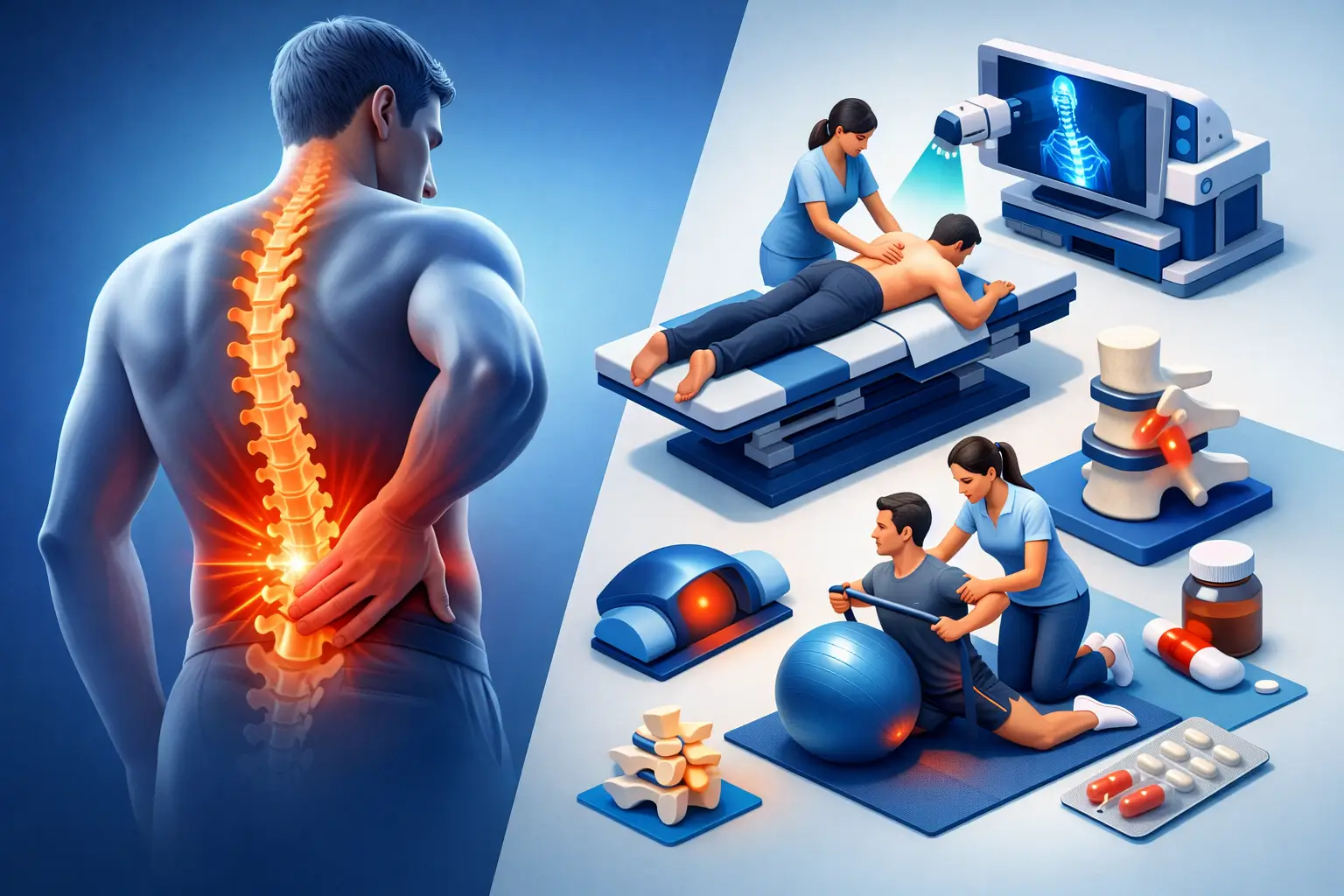
A back that hurts when you get out of the car, sit through a meeting, or try to sleep can make even ordinary routines feel uncertain. Understanding back pain causes and treatment begins with a simple but essential point: back pain is a symptom, not a single diagnosis. The right plan depends on which tissues are involved, how long symptoms have lasted, and whether the pain is affecting nerves, mobility, or daily function.
For some people, back pain improves with time and conservative care. For others, it becomes a persistent problem that limits work, exercise, independence, and sleep. A careful evaluation can identify the likely source of pain and help patients move beyond temporary symptom management.
Why Back Pain Has So Many Possible Causes
The spine is a complex structure of bones, discs, joints, ligaments, muscles, and nerves. Pain may originate in one structure or arise from several issues at once. For example, a person may have age-related disc changes but experience their most limiting pain from inflamed facet joints or muscle guarding.
Acute back pain often follows a strain, awkward lift, prolonged bending, fall, or sudden change in activity. Muscles and ligaments can become irritated when they are overloaded, particularly after a period of inactivity. This type of pain may feel sore, tight, or sharp with certain movements and commonly improves over several weeks.
Chronic back pain is more likely to involve ongoing joint, disc, nerve, or structural concerns. It can also persist after an injury has healed because the nervous system, movement patterns, and surrounding muscles have adapted to protect the painful area. That does not mean the pain is “all in your head.” It means a complete plan may need to address more than one contributor.
Common mechanical sources of pain
Degenerative disc disease is a common finding as people age. Spinal discs gradually lose water content and flexibility, which can contribute to stiffness or pain with sitting, bending, and lifting. Imaging changes alone do not always explain a person’s symptoms, however. Many adults have disc degeneration without significant pain, which is why clinical examination matters as much as a scan.
Facet joint arthritis is another frequent source of lower back pain. These small joints help stabilize the spine. When they become irritated or arthritic, pain may worsen with standing, leaning backward, twisting, or prolonged walking. It is often felt in the lower back and buttocks rather than traveling far down the leg.
Sacroiliac joint dysfunction can cause pain near one or both sides of the lower back, often below the beltline. It may be mistaken for hip pain or sciatica. Pregnancy, prior injury, altered gait, arthritis, and changes in spinal mechanics can all contribute.
Compression fractures, more common in people with osteoporosis, can cause sudden and substantial pain after a fall, a minor injury, or sometimes no obvious injury at all. These fractures deserve prompt medical attention because early treatment may help protect function and reduce complications.
When nerves are involved
A herniated disc or spinal narrowing can irritate or compress a nerve root. This may lead to sciatica, which typically causes burning, electric, shooting, or aching pain that travels from the lower back or buttock into the leg. Numbness, tingling, or weakness can also occur.
Spinal stenosis refers to narrowing of spaces in the spine where nerves travel. It is often associated with arthritis-related changes and may cause leg heaviness, pain, or numbness while standing or walking. Some people notice relief when leaning forward over a shopping cart or sitting down.
Nerve-related symptoms require a more focused evaluation because the treatment approach differs from that used for a simple muscle strain. The pattern of symptoms, physical examination, and appropriate imaging can help clarify whether a nerve is being affected and where.
When Back Pain Needs Urgent Evaluation
Most episodes of back pain are not emergencies, but certain symptoms should never be ignored. Seek immediate medical care for new loss of bowel or bladder control, numbness in the groin or inner thighs, rapidly worsening leg weakness, or severe pain after major trauma.
Prompt evaluation is also appropriate for back pain with fever, unexplained weight loss, a history of cancer, significant immune suppression, or pain that is severe and unrelenting at night. These symptoms do not automatically mean a serious condition is present, but they warrant timely assessment.
Back Pain Causes and Treatment: Matching Care to the Source
Effective treatment is not simply a matter of finding the strongest medication. The goal is to reduce pain while restoring the ability to move, work, sleep, and participate in life. For many patients, that begins with a detailed history and examination that considers pain location, triggers, prior injuries, neurologic symptoms, medical conditions, and previous treatments.
Early treatment for uncomplicated mechanical pain may include temporary activity modification, guided exercise or physical therapy, heat or ice, and carefully selected anti-inflammatory or non-opioid medications when appropriate. Complete bed rest is rarely helpful. Gentle, progressive movement usually supports recovery better than avoiding all activity.
Physical therapy can be especially valuable when weakness, poor movement mechanics, reduced flexibility, or fear of movement is prolonging symptoms. The best program is individualized. A person with pain triggered by repeated bending needs a different approach from someone whose symptoms worsen with standing and extension.
When conservative measures have not provided enough relief, interventional pain management may offer a more precise next step. Image-guided procedures can target structures identified during the evaluation, often with the goal of reducing inflammation or interrupting pain signals while a patient continues rehabilitation.
For example, an epidural steroid injection may be considered for certain cases of radicular pain or sciatica caused by nerve inflammation. Facet joint injections or medial branch blocks may help determine whether facet joints are driving pain. If diagnostic blocks provide meaningful but temporary relief, radiofrequency ablation may offer longer-lasting relief by treating the small nerves that carry pain signals from those joints.
Sacroiliac joint injections may be appropriate when the exam and symptom pattern point to the SI joint. For painful vertebral compression fractures, kyphoplasty can be considered in selected patients to stabilize the fracture and potentially reduce pain. These treatments are not interchangeable, and not every patient is a candidate. Precision depends on identifying the most likely pain generator rather than using a one-size-fits-all procedure.
Surgery may be necessary when there is significant neurologic compromise, spinal instability, a fracture, or a structural problem that has not responded to appropriate nonsurgical care. Still, surgery is not automatically the best answer for every abnormal MRI finding. A thoughtful specialist will weigh the severity of symptoms, functional impact, examination findings, imaging, treatment history, and the expected benefit of each option.
The Role of Imaging and Diagnosis
An X-ray, MRI, or CT scan can provide useful information, but imaging should answer a clinical question rather than replace a clinical evaluation. Scans can reveal disc herniations, arthritis, fractures, narrowing, or other changes, yet many findings are also present in people without pain.
This is why a physician-led assessment matters. The most meaningful diagnosis connects the scan, physical examination, symptom pattern, and a patient’s goals. If low back pain is preventing someone from standing long enough to prepare dinner, returning to that function is more meaningful than treating an image alone.
Building a Plan for Lasting Relief
Persistent pain can affect mood, sleep, relationships, and confidence in movement. A plan that addresses only the pain score may miss what matters most. At Global Pain Solutions, care is centered on identifying the source of pain, considering minimally invasive options when appropriate, and helping patients pursue durable improvements in comfort and function.
Long-term progress often includes a combination of targeted treatment and practical habits. Regular low-impact activity, gradual strengthening, attention to body mechanics, healthy sleep, and weight management when relevant can all reduce strain on the spine. These steps are not a substitute for medical care when symptoms are severe, but they can help protect the gains made through treatment.
Back pain does not have to dictate every decision you make. When pain persists, spreads into the leg, or keeps you from living normally, a focused evaluation can provide clarity and a path forward that is built around your condition, your goals, and your quality of life.