
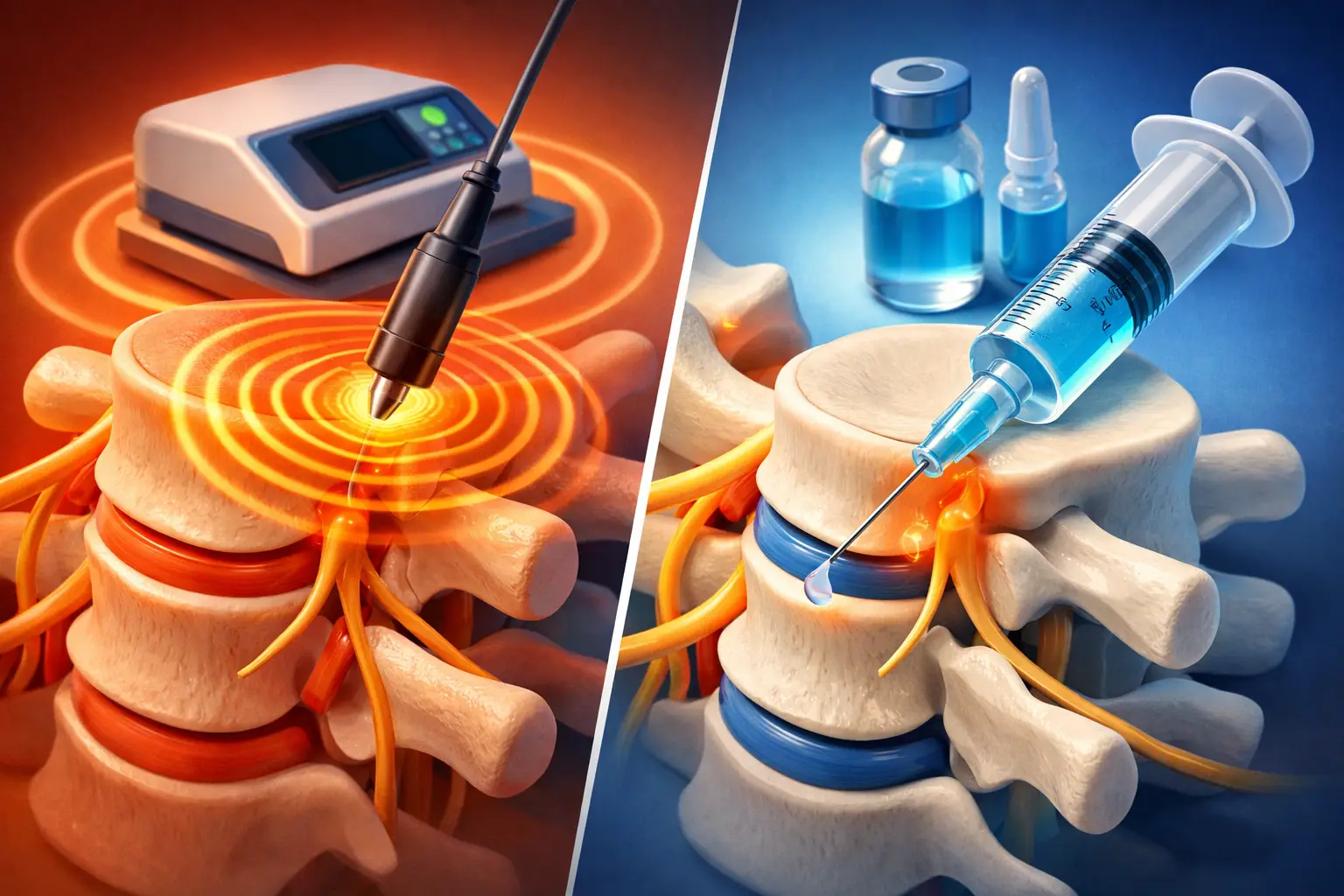
A sore lower back after a long workday, pain when turning your head to check traffic, or knee pain that limits a simple walk can all have different causes. That is why the choice between radiofrequency ablation vs injection is not simply a question of which procedure is stronger. The right option depends on the structure causing pain, the role of inflammation, prior treatment response, and the level of relief needed to restore daily function.
Both treatments are minimally invasive and commonly used in interventional pain management. They can reduce pain without relying on long-term opioid medication or moving immediately to surgery. However, they work in different ways and are often used at different points in a personalized care plan.
Radiofrequency Ablation vs Injection: The Core Difference
Injections generally deliver medication to a targeted area. Depending on the procedure, that medication may reduce inflammation, calm irritated tissue, lubricate a joint, or temporarily numb a suspected pain source. An injection may be used both to treat symptoms and to help clarify the diagnosis.
Radiofrequency ablation, often called RFA, does not deliver steroid medication. Instead, it uses carefully controlled heat generated by radiofrequency energy to interrupt pain signals from select small sensory nerves. The nerve does not control muscle strength or movement. Its primary role is to carry pain information from a specific joint or region to the brain.
RFA is most often considered for longer-lasting pain related to facet joints in the spine, sacroiliac joints, or certain knee pain patterns. It is typically performed only after diagnostic nerve blocks show that the targeted nerves are likely responsible for a significant portion of a patient’s pain.
The distinction matters. An injection may be appropriate when inflammation is active or when the pain generator is still being identified. RFA may be a better next step when diagnostic blocks provide substantial but temporary relief from a well-defined nerve pathway.
When an Injection May Be the Better First Step
The word “injection” covers several procedures, and each serves a different purpose. Epidural steroid injections may be used when inflamed spinal nerves contribute to radiating pain, numbness, or tingling from conditions such as a disc herniation or spinal stenosis. Joint injections can be used for arthritis-related pain in areas such as the knee, shoulder, hip, or facet joints. Trigger point injections and sympathetic blocks have other targeted roles.
For many patients, an injection is not a one-size-fits-all solution. It is chosen based on the location of pain, examination findings, imaging when appropriate, and the pattern of symptoms. For example, pain traveling from the lower back into the leg may call for a different approach than pain that stays centered in the low back and worsens with extension or twisting.
Injections can offer meaningful relief, sometimes within days and sometimes over a longer period as inflammation settles. The duration varies widely. Some people experience relief for weeks or months, while others may have a shorter response. A limited response is still useful clinical information because it can help the physician determine whether the medication reached the correct source of pain.
An injection may be especially appropriate when pain has flared recently, inflammation is believed to be a major contributor, or a patient needs symptom relief to participate more fully in physical therapy and activity-based recovery.
When Radiofrequency Ablation May Be Worth Considering
RFA is usually not the first procedure performed for chronic joint-mediated pain. Before moving forward, a physician commonly uses one or more diagnostic medial branch blocks or other targeted nerve blocks. These procedures temporarily numb the small nerves that carry pain from the suspected joint.
If the block produces meaningful, time-limited relief during the expected anesthetic window, it supports the idea that those nerves are an appropriate RFA target. This diagnostic step helps avoid treating the wrong structure and reflects the precision required for effective interventional pain care.
For qualified patients, RFA can provide relief that lasts longer than a typical injection. Many patients experience improvement for several months, and some have relief for longer. The treated nerves can regenerate over time, so pain may eventually return. When prior RFA provided meaningful benefit and the clinical picture remains consistent, the procedure may sometimes be repeated.
RFA is not designed to repair arthritis, reverse a disc problem, or remove pressure from a severely compressed nerve. It reduces pain signaling from a selected source. That reduction can make it easier to walk, sleep, work, exercise, and complete the rehabilitation steps that support long-term function.
Comparing Relief, Recovery, and Risks
Both injections and RFA are typically performed using imaging guidance to support accurate needle placement. Most patients return home the same day, although activity restrictions and recovery instructions vary by procedure.
Injection results can be quicker when local anesthetic is part of the treatment, though that initial numbness is temporary. Steroid-related benefit, when steroid is used, may take several days to develop. Some patients experience temporary soreness or a brief pain flare after an injection.
After RFA, soreness at the treatment site is also common for several days. The full benefit may not be immediate because the irritated nerve tissue and surrounding area need time to settle. Some people notice gradual improvement over two to six weeks.
No procedure is without risk. Potential concerns may include bleeding, infection, temporary numbness, post-procedure soreness, allergic reaction, or an incomplete response. Steroid injections also require individualized consideration for people with diabetes, certain infections, or other medical conditions because steroids can affect blood sugar and immune response. RFA has its own considerations, including the need to confirm that the targeted nerve is truly involved in the pain pattern.
A board-certified pain management specialist reviews medications, medical history, imaging, and procedural risks before recommending either treatment. Blood-thinning medications, implanted devices, pregnancy, uncontrolled medical conditions, and active infection may affect timing or candidacy.
The Best Choice Depends on the Pain Generator
A useful question is not, “Which procedure is better?” It is, “What is most likely causing my pain?” Chronic pain can involve more than one structure at the same time. A patient may have arthritis-related facet pain in the low back, for example, along with a disc issue that causes leg symptoms. One procedure may help one component without resolving every symptom.
RFA is often most useful for pain that is localized and linked to a specific sensory nerve pathway, particularly when diagnostic blocks have been strongly positive. Injections are broader in application. They may target inflamed nerve roots, joints, soft tissue, or other structures depending on the diagnosis.
The duration and character of symptoms also matter. New or worsening weakness, progressive numbness, loss of bowel or bladder control, fever, or pain after major trauma requires prompt medical evaluation rather than routine procedural planning. These symptoms can indicate a more urgent condition.
What a Personalized Treatment Plan Looks Like
At Global Pain Solutions, treatment planning begins with more than identifying where pain is felt. A careful evaluation considers when the pain began, what movements provoke it, previous procedures or surgeries, imaging findings, medication history, and the goals that matter most to the patient. For one person, the goal may be returning to a golf swing. For another, it may be standing long enough to prepare a meal or sleeping through the night.
A plan may include targeted procedures alongside physical therapy, guided exercise, medication adjustments, chiropractic care when appropriate, or other therapies. The goal is not to perform a procedure for its own sake. It is to use the least invasive option that has a reasonable chance of reducing pain and improving function.
Sometimes an injection is the appropriate starting point, followed by reassessment. Sometimes a successful diagnostic block makes RFA the more logical next step. And sometimes neither procedure is the best answer until the diagnosis is clearer. That individualized approach protects patients from unnecessary treatment while keeping the focus on meaningful, durable progress.
Pain relief is most valuable when it creates room for life again. A thoughtful evaluation can clarify whether an injection, radiofrequency ablation, or another targeted treatment offers the most practical path toward moving with greater comfort and confidence.