
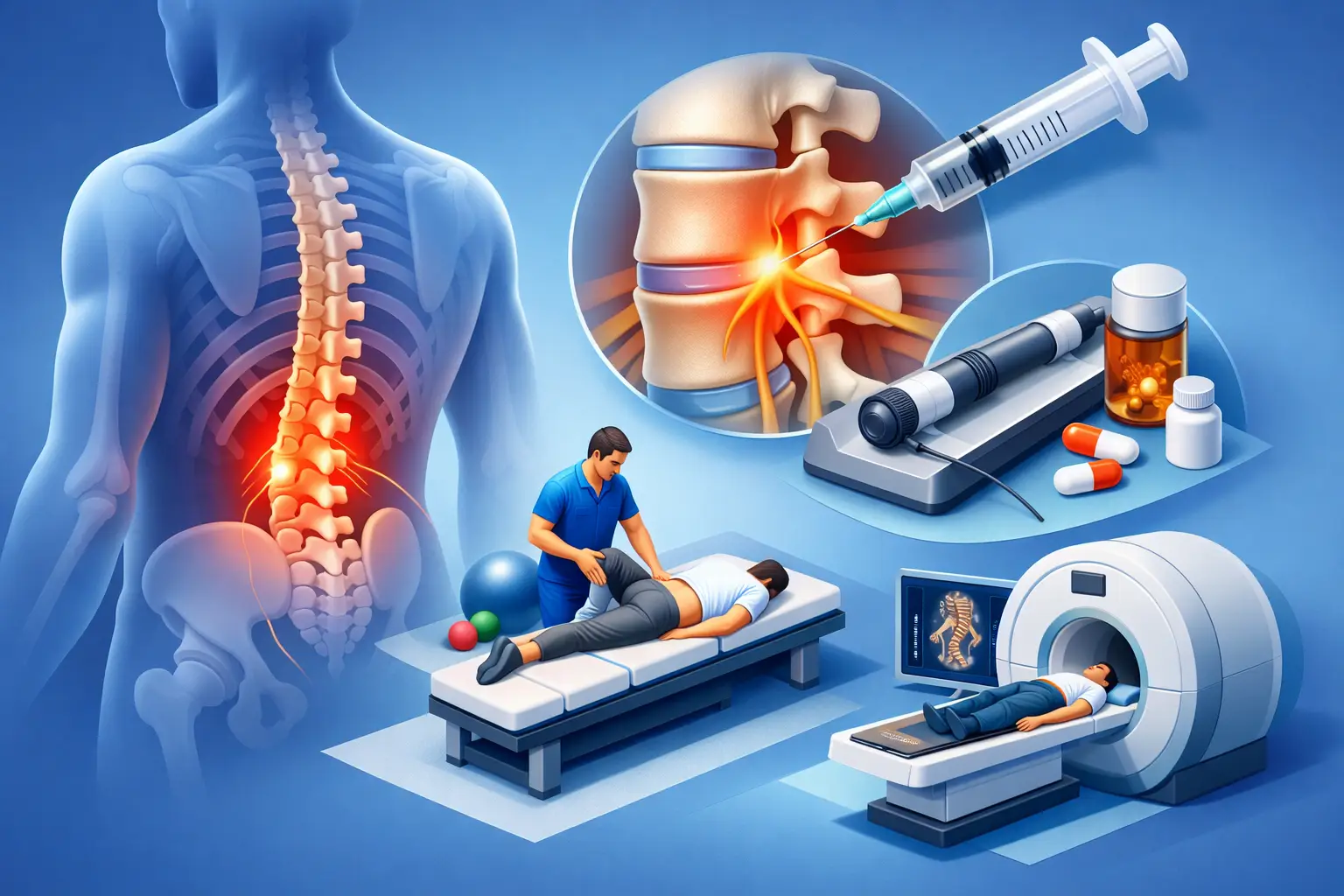
Lumbar radiculopathy can make a short drive, a work meeting, or a walk through the grocery store feel like an endurance test. Often called sciatica when it affects the sciatic nerve distribution, it occurs when a nerve root in the low back becomes irritated or compressed. The best treatments for lumbar radiculopathy do more than temporarily quiet pain. They identify what is placing stress on the nerve, protect function, and use the least invasive option likely to help.
The right plan depends on the cause. A herniated disc, spinal stenosis, bone spur, degenerative disc changes, or narrowing around the nerve can all produce similar symptoms, including burning pain down the leg, tingling, numbness, or weakness. That is why a personalized diagnosis matters before choosing a procedure, medication, or surgery.
Start by Confirming the Source of Nerve Pain
Low back pain alone is not always lumbar radiculopathy. True radicular pain usually follows a recognizable path from the low back or buttock into the thigh, calf, or foot. Some people feel electric or burning pain; others notice that coughing, sitting, standing, or walking makes symptoms worse. Weakness in lifting the foot, climbing stairs, or pushing off while walking can signal more significant nerve involvement.
A pain specialist begins with a detailed history and physical examination, including strength, reflexes, sensation, gait, and movements that reproduce symptoms. Imaging such as an MRI may be helpful when symptoms are severe, persistent, or accompanied by neurologic deficits. The goal is not simply to find an abnormality on a scan. Many adults have age-related spinal changes without symptoms. The meaningful finding is the one that matches the patient’s pain pattern and examination.
Urgent evaluation is needed for new bowel or bladder changes, numbness in the groin or saddle area, rapidly worsening leg weakness, fever with severe back pain, or symptoms after major trauma. These signs can point to conditions that require prompt medical attention rather than a routine pain appointment.
Best Treatments for Lumbar Radiculopathy: A Layered Plan
For many patients, treatment begins conservatively, especially when pain is recent and strength is intact. However, conservative care should be active and purposeful. Repeating the same approach for months despite worsening function is not a long-term plan.
Targeted physical therapy and guided activity
Rest may calm a severe flare briefly, but extended bed rest can increase stiffness, weaken supporting muscles, and make returning to activity harder. A skilled physical therapy program focuses on the movements and positions that reduce nerve irritation while gradually rebuilding strength, mobility, balance, and confidence.
The program may include core stabilization, hip and leg strengthening, posture training, and nerve mobility exercises. For a disc-related problem, certain extension or flexion movements may be more comfortable depending on the individual. For spinal stenosis, walking tolerance may improve with a different approach than it would for a disc herniation. The treatment should fit the diagnosis, not follow a generic exercise sheet.
Medication used with a clear purpose
Anti-inflammatory medications may help some patients during a short-term flare if they can be used safely. Other medications can sometimes reduce nerve-related burning, tingling, or sleep disruption. These options require careful review of kidney function, blood pressure, stomach risks, sedation, medication interactions, and other health considerations.
Medication can create enough comfort to participate in rehabilitation, but it rarely corrects meaningful nerve compression by itself. Long-term opioid therapy is generally not the preferred answer for lumbar radiculopathy because it does not address the mechanical source of pain and carries substantial risks. A thoughtful medication plan should support function while the underlying condition is being treated.
Image-guided epidural steroid injections
When leg pain remains limiting despite appropriate conservative care, an epidural steroid injection may offer meaningful relief. This minimally invasive treatment delivers anti-inflammatory medication into the epidural space near the irritated nerve root, using imaging guidance for precision.
For a patient with a disc herniation and acute radiating leg pain, a targeted transforaminal epidural injection may be considered. Other epidural approaches can be more appropriate when symptoms involve multiple levels or central spinal stenosis. The best route depends on anatomy, imaging findings, prior surgery, and the location of nerve irritation.
An injection is not a cure for every structural problem, and response varies. Some patients experience enough reduction in pain to resume therapy, work, and normal movement; others get only brief or incomplete benefit. Even when relief is temporary, the response can provide useful diagnostic information and help guide the next treatment decision. Procedures should be performed by an experienced physician using appropriate imaging and safety protocols.
Addressing related pain generators
A patient can have lumbar radiculopathy and additional sources of pain at the same time. Facet joints, sacroiliac joints, hip arthritis, muscle guarding, and post-surgical scar tissue may all contribute to disability. Treating only one component can leave patients wondering why they are still limited.
This does not mean every painful area needs a procedure. It means the care plan should account for the full clinical picture. Diagnostic blocks or targeted joint injections may be appropriate when the examination suggests a separate pain generator. Radiofrequency ablation can be useful for carefully selected facet-mediated back pain, but it is not a direct treatment for a compressed lumbar nerve root. That distinction protects patients from procedures that do not match the problem.
Surgery when nerve compression threatens function
Surgery is not automatically required for a herniated disc or spinal narrowing. Many cases improve without it. Yet surgery may be the most appropriate option when there is progressive weakness, severe and persistent leg pain that has not responded to well-directed nonsurgical care, or anatomy that clearly creates ongoing nerve compression.
Procedures such as microdiscectomy or decompression surgery can relieve pressure on the affected nerve in appropriately selected patients. The decision should be based on symptoms, neurologic findings, imaging, overall health, and personal goals. An interventional pain specialist can help patients understand when a minimally invasive pain procedure is reasonable and when a spine surgical opinion is the safer next step.
Advanced options for persistent or post-surgical nerve pain
Some patients continue to have significant nerve pain after spine surgery or are not candidates for additional surgery. In select cases, spinal cord stimulation may be considered. This therapy uses a small implanted system to modify pain signaling before it reaches the brain. A temporary trial allows the patient and physician to assess whether it provides worthwhile relief and functional improvement before permanent implantation is considered.
Spinal cord stimulation is not a first-line treatment for a new episode of radiculopathy. It is an advanced option for carefully screened patients with persistent, treatment-resistant pain, particularly when further corrective surgery is unlikely to help.
What a Successful Treatment Plan Should Change
Pain scores matter, but they are not the only measure of progress. A successful plan should help a patient stand longer, sleep more comfortably, return to work tasks, walk with less fear, or participate in family life again. Those practical gains often show whether treatment is addressing the true problem.
At Global Pain Solutions, care for lumbar radiculopathy is built around this functional goal. After reviewing symptoms, examination findings, imaging, prior treatments, and individual health needs, Dr. Nikesh Seth can help determine whether rehabilitation, a precisely targeted injection, medication support, advanced intervention, or surgical referral offers the best path forward.
Living with radiating leg pain can make it easy to postpone care until symptoms become overwhelming. Earlier evaluation is especially valuable when numbness, weakness, declining mobility, or repeated flares are changing how you live. A precise diagnosis and a treatment plan designed around your function can create a clearer path back to the activities that matter to you.